AI layoffs 2026: 230,896 tech jobs cut this year, and the counters do not agree
The short version
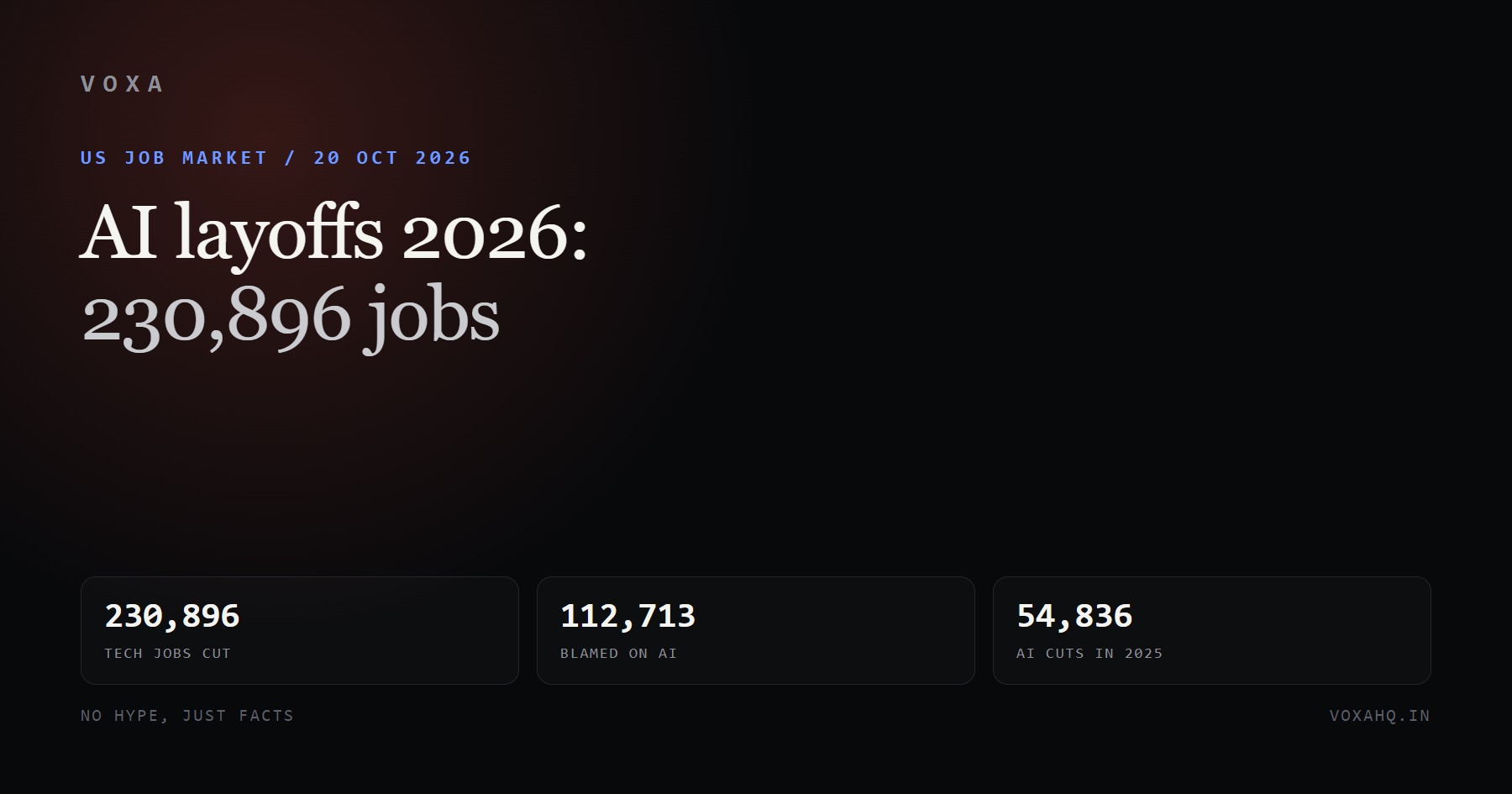
Two trackers counting the same year disagree by more than 36,000 jobs. Challenger, Gray and Christmas counted 112,713 US job cuts blamed on AI through July 2026, about 24 percent of all announced cuts and more than double the AI-cited total for all of 2025. The counter-argument is just as well sourced: Goldman Sachs found AI added back about 9,000 jobs a month while removing 16,000.
The two numbers
TrueUp’s tech layoff tracker reports 653 layoff events at tech companies in 2026 with 194,600 people affected, about 664 a day. Skillsyncer reports 553 events with 230,896 people affected, about 788 a day. Both were read on 20 October 2026.
The gap is methodology. One counts company announcements, the other counts verified headcount, and neither claims to be the official figure. If you quote one number in a meeting, quote where it came from.
Who is cutting
| Company | Cut | When |
|---|---|---|
| Oracle | 30,000 | 31 March 2026 |
| Amazon | 17,000+ | 2026, across teams |
| Cognizant | 15,000 | 2026, automation shift |
| Meta | 10,400 | Multiple rounds |
| Netflix | About 1,000 (6%) | 14 October 2026 |
| HubSpot | 660 (7%) | 7 October 2026 |
| Flock Safety | 270 (18%) | 9 October 2026 |
The pattern inside those cuts is consistent. Customer support, content moderation, data entry, QA testing and general software engineering take the hit. Machine learning infrastructure, AI safety, applied research, healthcare and skilled trades are still hiring.
How much of it is actually AI
Challenger, Gray and Christmas counted 112,713 announced US job cuts attributed to AI through July 2026. That is roughly 24 percent of the 477,033 cuts announced in the period, and more than double the 54,836 cuts blamed on AI in all of 2025. By September the firm’s count had risen to 120,136.
The important word is attributed. Challenger counts the reason an employer gives in its own announcement. It is not an independent finding that AI caused the cut.
That gap has a name now: AI washing, or AI redundancy washing. Deutsche Bank analysts flagged it as a 2026 trend, and OpenAI’s chief executive has acknowledged that some companies blame AI for decisions they would have made anyway. Jack Dorsey’s Block cut almost half its staff in February and cited AI directly, which is the version where the claim is at least specific.
The counter-evidence
Goldman Sachs found that AI reduced monthly US payroll growth by about 16,000 jobs over the past year, while adding about 9,000. A net loss of roughly 7,000 a month is real, and it is nothing like the disruption implied by a 112,713 headline.
PwC’s 2026 AI Jobs Barometer goes further: headcount growth at the most AI-exposed companies is outpacing growth at the least exposed. The firms hiring hardest for AI are, on average, also growing. That is the opposite of the story most layoff coverage tells.
Both can be true at once. AI is reshaping which jobs exist inside a company while increasing total headcount at the companies adopting it fastest. The people affected are usually in different roles from the people hired, which is why the aggregate looks calm and the individual experience does not.
What this means if you work in tech right now
Three things follow from the data, and none of them require a prediction about 2027.
The risk is role-specific, not industry-wide. Support, moderation, data entry, QA and generalist engineering are where the overlap with current AI capability is highest. Infrastructure, safety, research and regulated domains are where hiring continues.
Announced reasons are marketing. A company that says AI caused a cut may be restructuring after overhiring in 2022. When you read a layoff story, check whether the number is a count of announcements or a count of people.
The hiring side is quieter than the cutting side. Layoffs get a headline; 9,000 monthly payroll additions do not. If you are job hunting, the openings exist in the roles above, and they are being filled by people who can show applied work rather than tool familiarity.
Questions people ask
How many layoffs has AI caused in 2026?
Challenger counted 112,713 US job cuts attributed to AI through July 2026, about 24 percent of all announced cuts. Skillsyncer puts AI-cited cuts at 179,831 workers across 212 events.
Are AI layoffs backfiring?
There is no US-wide evidence of mass rehiring yet. What exists is evidence that the attribution is loose: Goldman Sachs finds a much smaller net effect than the headline counts suggest.
Which jobs are safest from AI layoffs?
Roles with physical work, regulated judgment, or responsibility for AI systems themselves: skilled trades, healthcare, infrastructure, safety and applied research.
Sources
Challenger, Gray & Christmas via HRD America (19 October 2026) and NTD (19 October 2026); TrueUp tech layoffs tracker (20 October 2026); Skillsyncer layoffs tracker (20 October 2026); InformationWeek 2026 layoff tracker (16 October 2026); Goldman Sachs workforce research; PwC 2026 AI Jobs Barometer.
Read from the primary source on 20 October 2026. Prices and terms change, so check before you commit.