AI companies raise millions, then cut staff weeks later
The short version
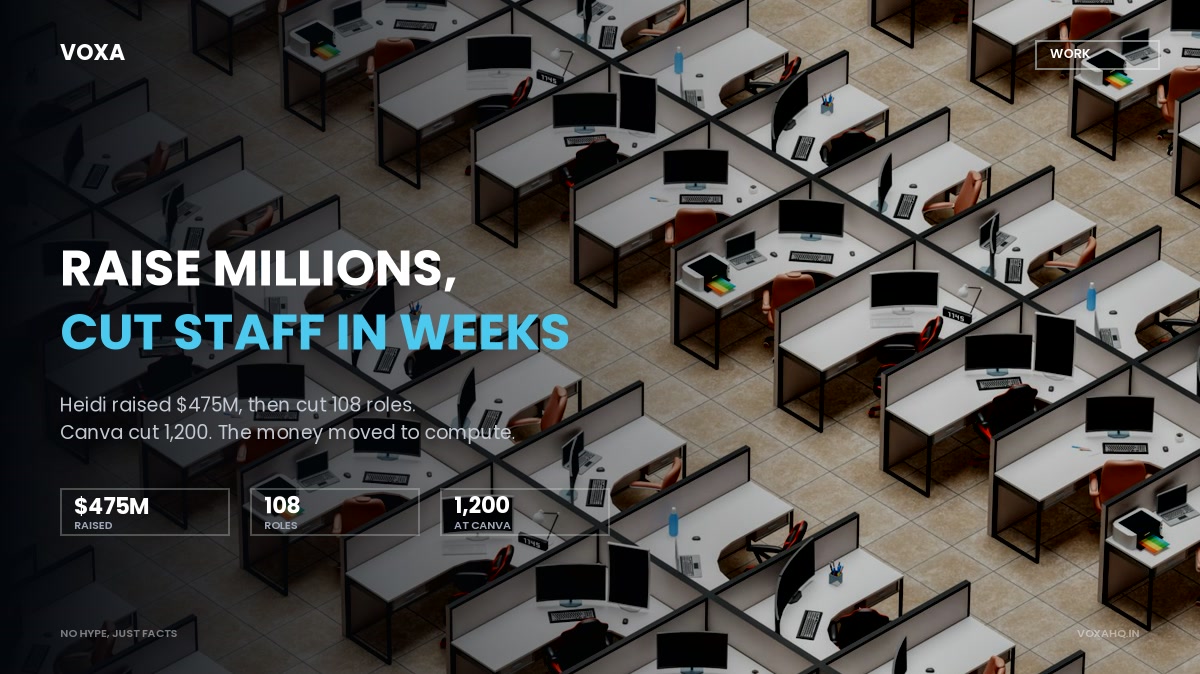
Heidi raised $475 million and cut 108 roles weeks later. Canva has been profitable for years and just cut 22 per cent of its staff, about 1,200 people. Both announcements were framed around AI. Neither came with a productivity number. The pattern is consistent enough now to name: capital is being redirected from headcount to compute, and the cuts are the visible half of that transfer.
Two data points from one week
Heidi, a Melbourne company selling AI scribing software to clinicians, told staff this week that it would remove 108 roles. The company had raised $475 million not long before, and the cuts arrived alongside the departure of a co-founder. It says severance exceeds statutory requirements in each country and that it is still hiring for key roles.
Canva cut deeper: about 22 per cent of its workforce, roughly 1,200 people, with some roles relocated rather than removed. Canva is not a struggling startup. It has been cash-generative for years, and it made a smaller cut in its finance division only months earlier.
Put side by side, the two announcements describe the same movement at different scales. A company raises money or has money, then spends it on compute rather than on people, and the people are told that AI changed the shape of the work.
Why the money moves
In a normal software company, revenue growth converts into hiring. You sell more seats, you need more support, more sales engineers, more account managers. The marginal cost of serving one more customer is mostly people.
In an AI-native company, that arithmetic changes. Serving one more customer costs inference, and inference is bought in advance through contracts with cloud and chip providers. Those commitments are enormous and they are signed years ahead. When a company raises $475 million or reports a strong quarter, a large share of that money is already promised to infrastructure before a single hire is approved.
That is why you see raises and cuts in the same quarter. The raise is for capacity, not for payroll. A company that has committed to compute has to hold headcount flat or reduce it to keep the unit economics working, because the compute bill arrives whether or not the customers do.
The part that is genuinely AI
None of that means the AI claims are false. Some of the work really is being automated. Support tiers, first-draft content, basic QA, design production, summarisation: these are tasks a model does acceptably today, and every one of them sits inside a job that used to require a person.
But "AI changed the work" and "we spent the money on GPUs" are compatible explanations, and only one of them is usually written in the memo. The productivity number is the thing that would separate them, and it is almost never published. If a company says a team now ships twice as fast, that is a measurement someone can check. If it says capabilities are advancing exponentially, that is a sentence about the industry, not about the company.
What this means for hiring
For job seekers, the signal is that the entry-level rung is the one being removed. The work that used to be given to a junior so they could learn the business is exactly the work that is now automated. Companies keep the people who can direct the tools and judge the output, and cut the layer that produced those people.
The consequence arrives two years later, when there is nobody trained to take the senior roles. That is the logic behind Gartner's projection that about 30 per cent of employees laid off for AI reasons will be rehired by 2029, at a higher cost than keeping them. The skill was not in the tool, it was in the person who knew what good looked like.
What the pattern does to the people inside it
There is a version of this that is easy to miss when the announcements are read as business news. A raise and a cut in the same quarter means two groups of people experience the same company very differently in the same month. One group is told the future is funded. The other is told their role is not part of it.
That changes how teams behave afterwards. The people who stay spend the next year watching whether the compute contracts turn into revenue, because if they do not, the next round is theirs. Hiring slows even where headcount is approved, because managers would rather leave a seat empty than fill it and lose it a quarter later. The company gets quieter and more cautious at exactly the moment it announces that it is moving faster.
None of that is an argument against spending on infrastructure. It is an argument for saying so plainly: we are shifting budget from salaries to compute, here is the number, here is what it buys, and here is when we will know whether it worked. Companies that publish that sentence keep more trust than the ones that say AI changed everything and leave the arithmetic out.
What to ask when you read the next announcement
Three questions separate a real automation story from a cost story. Which roles, specifically? What measured change in output justifies removing them? And is the work gone, or moved to a contractor, a partner or another country?
If a company answers all three, take the AI claim seriously. If it answers none, the honest summary is that it cut jobs and offered a reason that plays well. That may still be true. It has not been shown, and the difference matters if you are the one deciding whether to retrain, relocate or stay.