Google tells schools: ban AI and you lose Search too
The short answer
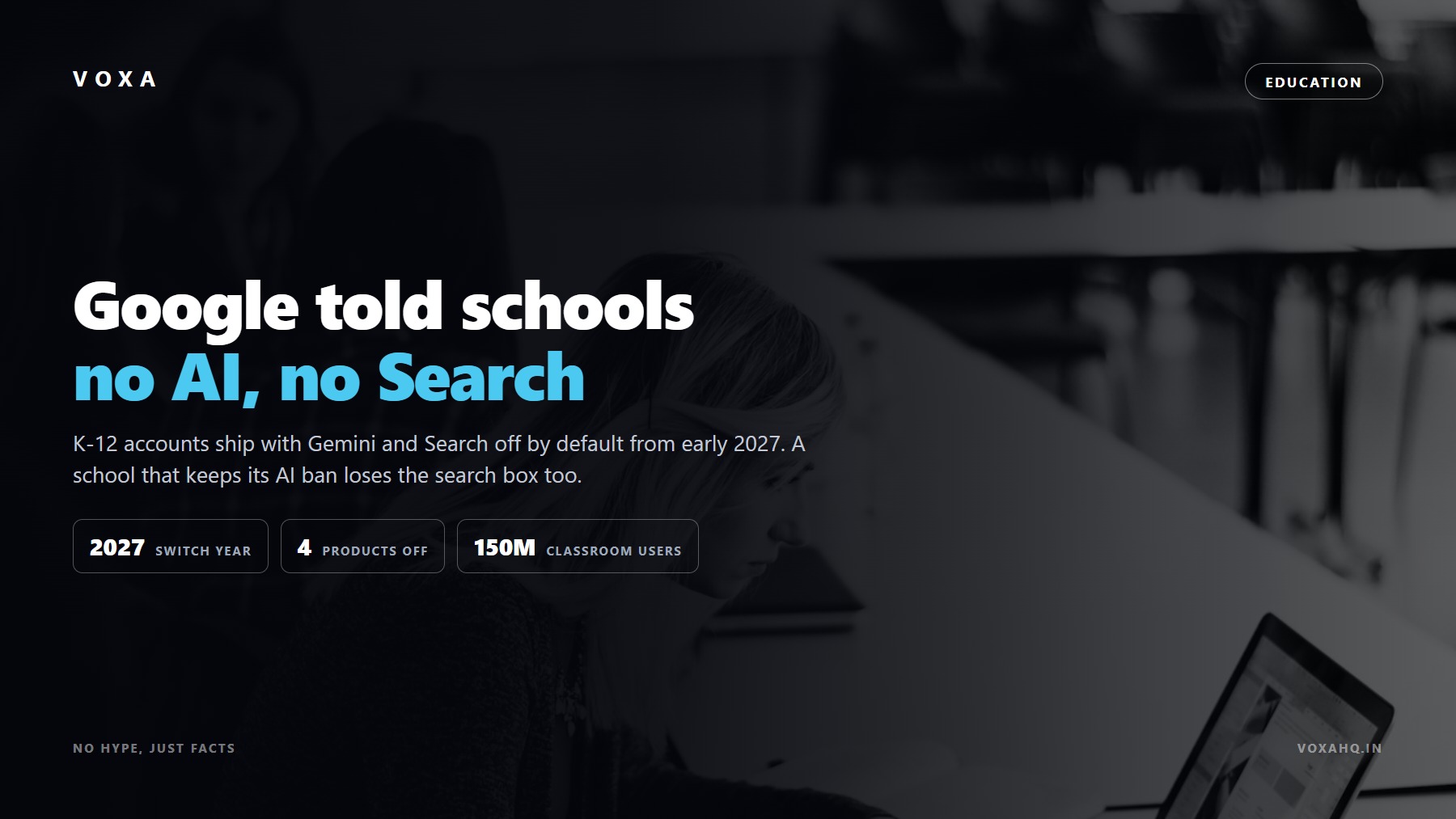
On 3 November Google told schools that from early 2027, K-12 student accounts will ship with Gemini, Gemini Notebook, Gemini in Classroom and Google Search all switched off until an administrator turns them on. A school that keeps AI switched off does not get plain search either. Google's position is that search and its AI features are one product, so the choice is AI with search or no search. New York, Los Angeles and Norway, which had already restricted AI in classrooms, are the test case.
What was announced
The change came in a blog post by Chris Phillips, vice president and general manager of Google's education division. Four products move to off by default for K-12 student accounts: Gemini, Gemini Notebook, Gemini in Classroom and Google Search. Schools get the controls; nothing turns on unless an administrator switches it on.
Google also said its Guided Learning mode, which walks a student through a problem with questions instead of handing over the answer, is coming to Search as a pilot at a few American schools from November, and is live globally inside Classroom from 3 November.
It reverses an August decision that turned Gemini in Classroom on by default for students of all ages. Three months later, the default belongs to the school's console instead.
Why there is no middle switch
The part that matters for schools is not the AI toggle. It is the coupling. AI Overviews appear at the top of results on their own, and AI Mode sits as a tab inside the same interface, so Google argues there is no setting that removes the generated answers and leaves the ten blue links.
Asked about schools that do not want AI, Phillips told Chalkbeat that such a school "has the choice to not have Search on at all". In an interview with the New York Times he put it the same way: search and AI are deeply integrated, and a student at a school that banned AI "will not have access to search".
Workarounds exist, and none of them are official. Third-party filters, a modified search URL, or moving to a different engine on managed Chromebooks. That last one is a project for a district, not a click for a teacher.
The schools this lands on hardest
New York suspended generative AI in schools up to eighth grade for a year. Los Angeles halted most AI tools for students. Norway banned generative AI in elementary schools outright. These are exactly the institutions that answered the question Google is now asking, and their answer was no.
Under the new default they would keep the ban and lose search on school accounts, which no principal is likely to sign off on. That is the pressure point: the rule survives on paper while the tool that makes it workable disappears.
The timing also follows a letter from Senators Blumenthal and Hawley to Sundar Pichai on 21 October with nine questions about AI in schools and student mental health, requesting answers by 2 November. The announcement landed the day after that deadline.
What it means outside the United States
Google's blog does not limit the change to American accounts, and Classroom is used by roughly 150 million students and teachers worldwide. Schools in the UK, Canada, Australia, India, Germany and Japan that run Workspace for Education will face the same console and the same choice, once Google publishes the technical details it says are coming "in the coming months".
No date has been given beyond the New York Times report pointing at early 2027, and no detail on how settings will apply to different groups of students. Until then, the current state holds: Gemini can be switched off per group, and the AI features inside Search cannot be switched off at all.
What to watch
- Whether Google publishes per-country timing, which decides how quickly this reaches schools outside the US.
- Whether any district with a written AI ban actually accepts losing Search, which would be the first real test of the ultimatum.
- Whether Guided Learning's learning gains hold up under studies that are not Google's own. Two Google studies in October found Gemini in classrooms had not improved test results.
For a school deciding this term, the practical move is boring: put the decision in writing, name who owns the console, and check what happens to search before the toggle is flipped, not after.