AI tool pricing index 2026: what nine tools actually cost
The short answer
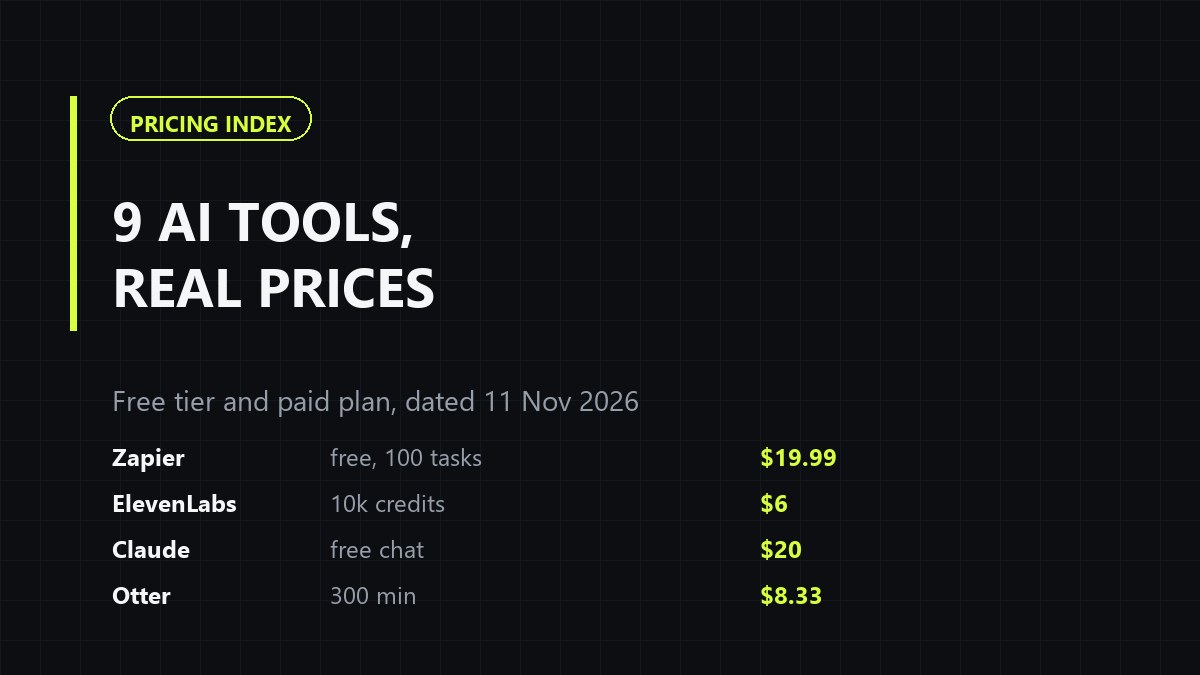
Nine AI tools that most small teams actually pay for, with the price read off the vendor's own page and the date it was read. The pattern is consistent: the entry plan is cheap ($6 to $29), the plan you end up on is two to five times that, and the free tier is limited by a feature rather than by usage. Everything below was checked on 10 or 11 November 2026.
The table
| Tool | Free tier | Cheapest paid | Plan most teams land on | Checked |
|---|---|---|---|---|
| Zapier | 100 tasks a month, two-step Zaps only | $19.99 Professional | Professional, by task volume | 10 Nov 2026 |
| ElevenLabs | 10,000 credits, no commercial licence | $6 Starter | $22 Creator (121,000 credits) | 10 Nov 2026 |
| Jasper | None | - | $59 a month billed yearly, $69 monthly | 10 Nov 2026 |
| Copy.ai | Limited free chat | - | $29 monthly, $24 billed yearly | 10 Nov 2026 |
| Notion | Personal, unlimited pages | $10 a member | Business, about $20 a member on yearly | 10 Nov 2026 |
| Claude | Free chat with daily limits | $20 Pro | Pro, or $17 a month billed yearly | 10 Nov 2026 |
| Otter | 300 transcription minutes a month | $8.33 a month on the yearly plan | Pro, about $16 monthly | 11 Nov 2026 |
| Descript | One transcription hour, watermarked 720p exports | $16 a month | Mid tiers, up to $65 a month on the top plan | 11 Nov 2026 |
| HeyGen | Free credits, watermarked video | $29 a month | $49 team plan | 11 Nov 2026 |
What we could not read, and why
Three vendors would not give a number to a plain page read, so they are listed here rather than guessed at:
- Make - the pricing page returns a 403 to a direct read. Its plan prices are widely quoted, but we have not confirmed them ourselves, so they are not in the table.
- n8n Cloud - the pricing page renders numbers in the browser, so a text read returns nothing. Self-hosting cost is covered in our n8n cost breakdown.
- ChatGPT Plus - the pricing page is client-rendered. The $20 figure in our guides comes from an October 2026 read, and we have not re-confirmed it this month.
That is the honest position. A price table that fills every cell by guessing is worse than one with three blanks.
The pattern worth knowing
1. The entry plan is not the product. Zapier's $19.99, ElevenLabs' $6 and Otter's $8.33 all exist to remove one specific limit: steps, the commercial licence, or minutes. They are not the plan anyone stays on.
2. The free tier is limited by a feature, not by usage. Zapier stops at two steps, ElevenLabs withholds the commercial licence, Otter stops at 300 minutes, Descript watermarks exports. The limit tells you where the paid line actually is.
3. Yearly billing is 15 to 25 per cent cheaper, and it locks you in. ElevenLabs' Creator is $22 monthly; the same plan on annual commitment works out lower, and during Black Friday it drops to $99 for the year. That discount only pays if you use it for most of the year.
4. The plan you need is usually one step above the one you priced. Every table like this undercounts, because the limit that bites is a feature - seats, credits, exports - rather than the headline number.
How we check a price
Three rules, applied to every row above.
Read the vendor's own page, not a review site. Affiliate blogs are routinely a year out of date, and the numbers get copied from one to the next.
Record the date with the number. A price without a date is a rumour. Every row here carries the day it was read.
If the page will not give a number, say so. Client-rendered pricing pages and bot blocks are common, and the right answer is a blank row with the reason, not a figure from memory.
Where the actual cost hides
The subscription is the visible cost. The three that are not:
- Seats. Notion and Otter both price per user; a five-person team is five times the number in the table.
- Credits. A plan quoted in credits hides the conversion rate. ElevenLabs' 121,000 credits is roughly 120 minutes of finished audio once retakes are counted, which is four minutes a week.
- The tool you buy because the first one stopped. The most common stack is two overlapping tools, which is the most expensive configuration there is.
What this means if you are choosing today
If you are a one-person operation, the honest answer is two subscriptions at most: one assistant plan and one tool that does the thing you cannot do yourself. Everything beyond that is a tool you bought because a thread told you to.
For a small team, the arithmetic changes at the seat line. Notion at $20 a member and Otter at $24 a user become the largest line items long before the "AI" part of the stack does, and neither of them is the tool you signed up to try.
For anyone automating work rather than writing with it, the choice is between Zapier's per-task pricing and self-hosted n8n, where the cost is a server and your time. Zapier is cheaper until your workflow runs often; n8n is cheaper until it breaks at 2am and nobody is watching, which is why we wrote a separate piece on catching a workflow that stops without an error.
Black Friday changes one number, not the pattern
The November window does not make these tools cheap. It moves the annual commitment price down: ElevenLabs' Creator annual drops to $99 from 16 November, and most of the rest run something similar. The entry plans stay the same, because the entry plans were never the discount target.
If you want the one offer we have tracked properly, it is on the ElevenLabs Black Friday page, with the dates and the case where taking it is a mistake.
How to reuse this table
Journalists, newsletter writers and anyone building a comparison can cite this page with the date on it. If you quote a number, quote the check date with it - that is the part that makes a price table worth anything.
Frequently asked questions
Which AI tool is cheapest to start with?
ElevenLabs Starter at $6 a month and Otter at $8.33 on the yearly plan are the lowest paid entry points on this list. Both exist to remove one limit, not to be a full plan.
Why is Zapier's free plan not really free for real work?
Because free Zaps are limited to two steps. The task allowance is 100 a month, but the step limit stops most workflows before they reach it.
Is yearly billing always cheaper?
It is cheaper per month and more expensive if you stop early. Yearly only wins if you use the tool for most of the twelve months.
Why are Make and n8n Cloud missing from the table?
Their pricing pages would not return readable numbers. We list the blank rather than quote a figure we have not checked.
How often is this page updated?
When a vendor changes a price that is already listed, and whenever a new tool is added. Every row carries its own check date so you can see how fresh it is.